What Is Water Soluble Organic Nitrogen Fertilizer?
Water Soluble Organic Nitrogen Fertilizer describes organic-derived nitrogen products that dissolve in water for use through irrigation or foliar application. The label sounds simple. The chemistry is not. Products can differ in nitrogen concentration, source materials, and how quickly microbes make nutrients available to plants. “Water soluble” does not always mean that every nitrogen form is immediately usable by a crop.
The FAO report World Fertilizer Trends and Outlook to 2022 projected global demand for nitrogen, phosphate, and potash nutrients at 201.7 million tonnes in 2022. That figure covers fertilizer nutrients broadly, not this specific product category. Still, it highlights the scale of nutrient management—and why accurate product claims matter. A grower should check the guaranteed analysis, application instructions, and compatibility with irrigation equipment. A jar test can reveal whether a product precipitates or clogs emitters before it reaches the field.
Soil scientist Dr. Rattan Lal, a World Food Prize laureate, has emphasized the importance of soil health. A fair paraphrase of his message is: “Nutrient gains should go hand in hand with protecting soil function.” That balance matters. Organic nitrogen may support a crop, but results depend on formulation, soil conditions, timing, and microbial activity. A label is only the starting point. A small trial plot, careful records, and crop observations can show whether the fertilizer performs as expected.
Definition and Key Characteristics of Water-Soluble Organic Nitrogen Fertilizer
What Is Water Soluble Organic Nitrogen Fertilizer?
Water-soluble organic nitrogen fertilizer contains nitrogen in carbon-based compounds that dissolve or disperse in water. These may include amino acids, short peptides, and soluble proteins, depending on the raw materials and processing. Unlike nitrate or ammonium fertilizers, much of its nitrogen must be converted by soil microbes before plants can use it. The speed of this process varies with soil temperature, moisture, and microbial activity.
Solubility can help distribute nutrients through irrigation or across a moist soil surface, but it does not guarantee immediate plant uptake. Product analysis, nitrogen form, and application rate matter.
The International Fertilizer Association’s 2022 report, World Fertilizer Trends and Outlook to 2026, projected global fertilizer demand at 208.5 million tonnes of nutrients in 2026, including 113.3 million tonnes of nitrogen. These figures cover fertilizer demand overall, not organic products specifically.
That distinction is easy to miss. A water-soluble label alone reveals little about how much nitrogen is available or how quickly it becomes available. Checking the guaranteed analysis and testing the soil can make application decisions more dependable. Even then, field conditions can surprise you.
Common Sources and Forms of Organic Nitrogen
Water-soluble organic nitrogen fertilizers often come from protein-rich materials. Common sources include fish or other animal protein hydrolysates, plant protein extracts, and carefully processed compost or manure extracts. Processing breaks larger proteins into smaller, soluble compounds. These may include free amino acids, short peptides, and some soluble proteins. Their proportions vary with the feedstock and manufacturing method.
Not all dissolve fully. A fertilizer described as water soluble may leave fine particles, so check its solubility guidance before using drip irrigation. Amino acids can be available to plants and soil microbes, while peptides may need further breakdown. The exact response depends on crop, temperature, and microbial activity. It is not always predictable.
Read the guaranteed analysis and application directions, rather than judging by color or smell. A laboratory analysis can confirm nitrogen content and help distinguish soluble nitrogen from total nitrogen. Compost extracts can be especially variable; two batches from similar materials may differ. This is where descriptions can get fuzzy. I would treat source labels as useful clues, not proof of identical nutrient behavior. Organic nitrogen may support a gradual nutrient supply, but it should not be assumed to release at a fixed rate in every soil.
What Is Water Soluble Organic Nitrogen Fertilizer? – Common Sources and Forms of Organic Nitrogen
| Source |
Common soluble nitrogen forms |
Typical characteristics |
Practical considerations |
Plant protein hydrolysate
Made from protein-rich materials such as legumes or oilseeds |
Free amino acids, short peptides, and some dissolved larger peptides |
Protein is broken down by enzymes or other processing methods to produce a liquid or soluble fraction. |
Composition and solubility vary with the feedstock and manufacturing process. Check product analysis and application directions. |
Animal protein hydrolysate
For example, processed fish or other animal proteins |
Amino acids, peptides, and other dissolved organic nitrogen compounds |
Hydrolysis increases the proportion of nitrogen present in dissolved, low-molecular-weight compounds. |
Products may differ in odor, salt content, and suspended solids. Filtration may be needed for fine irrigation equipment. |
| Enzymatic or fermented amino-acid solution |
Predominantly free amino acids, often with some small peptides |
Produced by breaking down protein or through fermentation; the exact amino-acid profile depends on the process and raw material. |
“Amino-acid” does not indicate a fixed nitrogen concentration. Use the guaranteed analysis to compare products. |
Soluble protein and peptide fractions
From processed plant or animal materials |
Dissolved peptides and proteins, alongside amino acids |
Some fractions dissolve readily, while others may form suspensions or settle depending on processing and water conditions. |
A product described as liquid or soluble may still contain particles; confirm compatibility before fertigation. |
| Soluble organic fractions from digestates or extracts |
A variable mixture of dissolved organic nitrogen compounds, which may include amino acids, peptides, and ammonium |
Composition depends strongly on the original material and treatment process; not all nitrogen in these materials is organic. |
Check nitrogen-form analysis, salinity, pH, and filtration requirements. Ammonium is inorganic nitrogen, even when present in an organic-material-derived product. |
Note: Water-soluble organic nitrogen is nitrogen in dissolved organic compounds, commonly amino acids and peptides. Solubility describes whether a material dissolves in water; it does not mean that all of its nitrogen is immediately available to plants. Availability and mineralization depend on the product, soil conditions, and microbial activity.
How It Dissolves and Supplies Nitrogen to Plants
What Is Water Soluble Organic Nitrogen Fertilizer?
How It Dissolves and Supplies Nitrogen to Plants
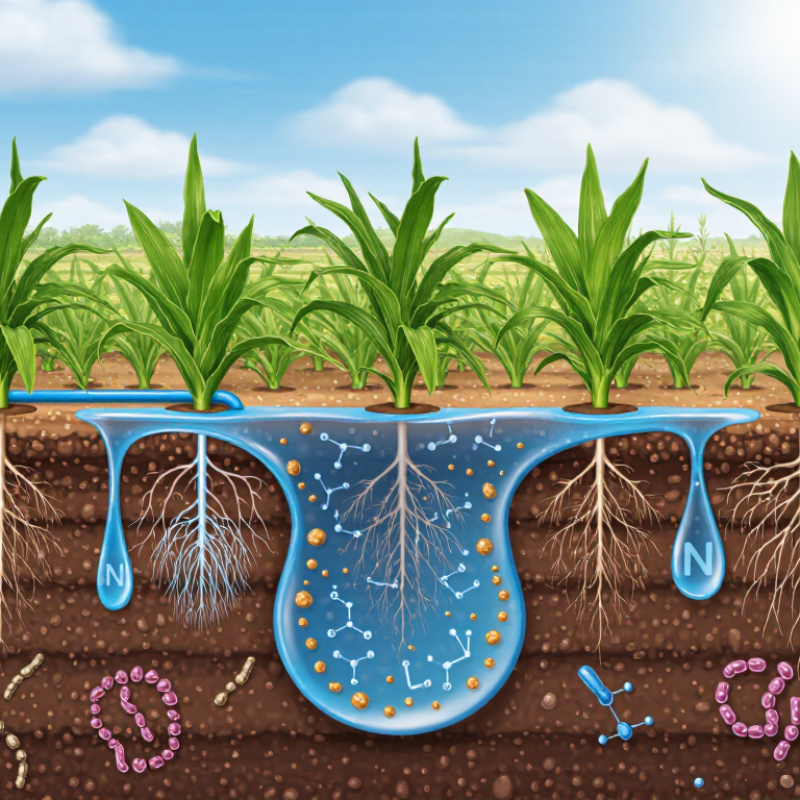
Water-soluble organic nitrogen fertilizer dissolves into irrigation water or a spray solution. Its nitrogen may come from amino acids, peptides, or other organic compounds. Dissolving spreads these compounds through the wetted soil, but it does not make every nitrogen molecule immediately available to roots. Some compounds can be absorbed directly; others need microbial breakdown into ammonium or nitrate. The process depends on soil temperature, moisture, oxygen, and microbial activity. A cool, dry bed can slow it down. Quite noticeably.
Think of a drip line wetting a narrow strip beneath a crop row. Dissolved nitrogen travels with that water, while microbes and roots gradually alter or absorb it. Avoid assuming that a clear solution guarantees uniform nutrition; clogged emitters, uneven watering, and soil differences can change delivery. The FAO’s 2019 State of Food and Agriculture estimated global nitrogen use efficiency at about 46 percent, meaning much applied nitrogen is not recovered by crops. That figure covers broad agricultural systems, not any one fertilizer. It is a useful caution, not a product-performance promise. Test the solution’s compatibility, follow soil or tissue results, and adjust rates to crop stage. Even good measurements leave some uncertainty.
Agricultural Uses and Application Methods
Water-soluble organic nitrogen fertilizer can be mixed with water for irrigation or foliar application. Depending on its source and processing, it may also supply small amounts of other nutrients. It can support leafy growth in vegetables, young fruit trees, and nursery plants when nitrogen is needed. Not a cure-all.
Follow the product label and, when available, use soil or plant tissue test results to guide rates. For drip irrigation, dissolve the measured amount fully and filter the solution if needed. Inject it into a clean system, then flush the lines with plain water to reduce deposits around emitters. For foliar feeding, dilute as directed and apply during cooler hours. Test a few leaves first. Avoid spraying stressed plants or blooms visited by pollinators.
The right rate depends on crop, growth stage, soil fertility, water quality, and nitrogen concentration. Begin conservatively; excess nitrogen can encourage soft, leafy growth and delay fruiting. Keep notes on application rates and crop response. Results can vary in cold soil or poorly maintained irrigation systems, so check the plants rather than assuming the treatment worked. Use the fertilizer within a balanced fertility plan, not as a substitute for soil testing or sound water management.
Benefits, Limitations, and Storage Considerations
What Is Water Soluble Organic Nitrogen Fertilizer?
Benefits, Limitations, and Storage Considerations
Water-soluble organic nitrogen fertilizer provides dissolved nitrogen from sources such as amino acids, peptides, or plant extracts. It can be applied through drip lines or foliar sprays, allowing precise placement and convenient dosing. But soluble does not mean instantly available to every crop. Microbes, soil temperature, and irrigation still affect how plants use the nitrogen.
Hartz and Johnstone’s 2006 HortTechnology incubation study found that, after two weeks, high-nitrogen organic fertilizers mineralized about 47% of their nitrogen, compared with 19% for lower-nitrogen products. These laboratory results are not a field guarantee, and the tested products do not represent every soluble formula. Cool or dry soil can slow nitrogen conversion. Frequent applications may also increase salt levels, while sediment can clog emitters. Not always predictable.
Store the product sealed in a cool, dry place, away from sunlight and standing water. Keep it in a clean, labeled container, and do not pour diluted leftovers back into the original package. Before fertigation, follow compatibility instructions and test a small mixture with the intended water. Separation, swelling, or unusual odor may signal a change, but appearance alone cannot confirm nutrient strength. Record the opening date and follow the stated shelf life. I would check the solution before applying it to a high-value crop; storage advice can be too general.